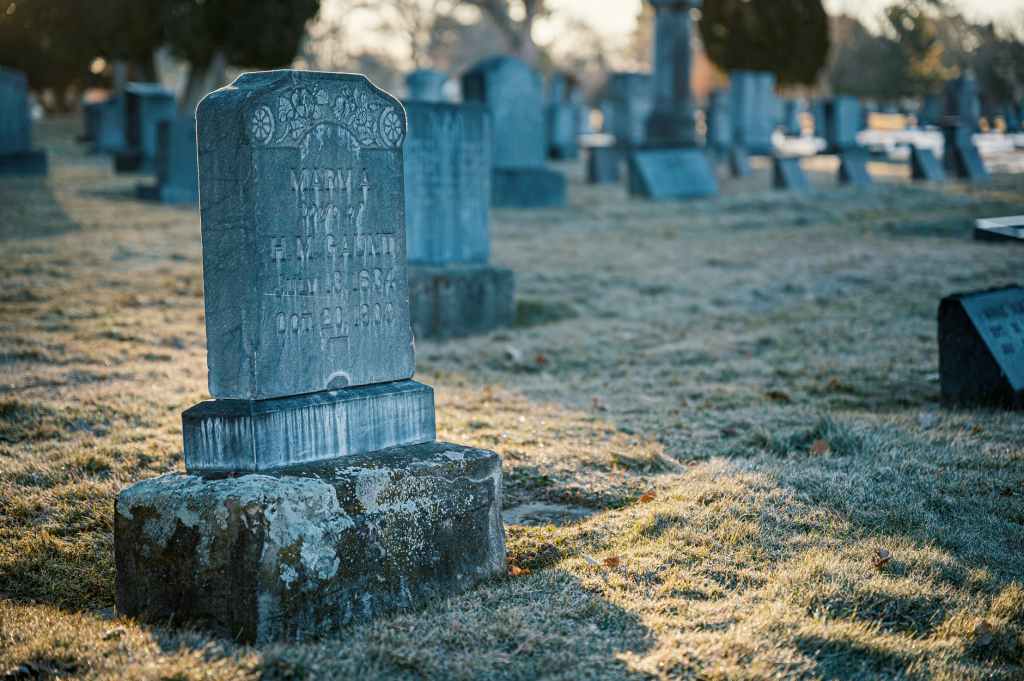
What do you call this?
I normally call the stones at cemeteries “headstones,” but some people call them gravestones, grave markers, memorial stones, memorials, tombstones, and sometimes there are also foot stones, name plaques, and other means of identification. I think it is just semantics for most people, but there is certainly a wide variety of “markers” to be found in a cemetery. From a genealogical standpoint, I hope to find a full name, a birthdate, and a death date, at a minimum on a headstone. This kind of information can go a very long way in supporting genealogical research. It might seem macabre to scour cemeteries for information about who is there, but I find it strangely peaceful and…exciting!
“How could it be exciting?” you might ask. One of the reasons I am drawn to genealogy is that all the people who came before us lived rich, interesting lives just like us. Mysteries can be solved by information on a headstone. It’s a bit sobering, of course, to realize that some of us will leave barely a trace, while others of us will leave an irrefutable legacy that follows us through time. Something like a headstone can last for centuries. Temporary markers may be all that gets placed at a burial location, however, and the elements will surely begin to destroy any information that had been there. These graves often end up “lost.”
Cemeteries have other issues that create a whole set of problems for genealogists and descendants. When they fall into a state of disregard, records get lost, sites become unmaintained, and headstones can be buried, overgrown, broken, and in the worst cases, removed. As cities grow and expand, what used to be a remote location can become prime real estate. There are laws to protect cemeteries and burials in the modern era, but there were fewer protections and far less consideration given to the dead in the not so long ago past. Overcrowding is another problem, making management of burial space a challenge in populous areas.
There are a few websites that are specifically dedicated to tracking cemeteries, burials, and cremations. Findagrave.com is a popular option. Billiongraves.com is another well-used site. I have done the majority of my research in the United States, so I am unsure what other websites may be available in other countries. Also, some cemeteries have their own dedicated webpages, which can make finding an old grave much easier. It has also become fairly common for funeral homes to provide web access to burial sites and obituaries.
If you are curious about headstones relating to your family, but they are distant from where you live, both Findagrave.com and Billiongraves.com are designed to give you access to cemeteries and photographs of headstones virtually. You can create individual memorial pages for your family and request photos of the headstones if you don’t have one. Findgrave.com seems a little more user friendly, but I just started using Billiongraves.com recently (and haven’t gotten to use it much yet).
Findagrave.com also has the ability to link pages together by relationships, e.g. mother, father, spouse, etc. I confess that one of my pandemic projects was to link families together when I found them “unlinked” on Findagrave. It was very satisfying to “reunite” children and parents and spouses in that way (my links are always supported by additional research sources).
I will be posting some tutorials soon, but until then, please reach out. If I can answer a question for you, I’ll certainly do my best to respond quickly!
Happy hunting!
 The History Chaser